
Posted on Oct 5
Getting a Polymarket trading bot to place orders is one problem.
Keeping it running correctly for days or weeks is a different problem.
A bot can work perfectly in a local test and still fail in production because of:
- WebSocket disconnects
- stale market data
- partial fills
- position mismatches
- execution uncertainty
- process restarts
- memory or resource problems
- failed API requests
- unreconciled state
- risk limits being reached
The strategy may be fine.
The problem is everything around the strategy.
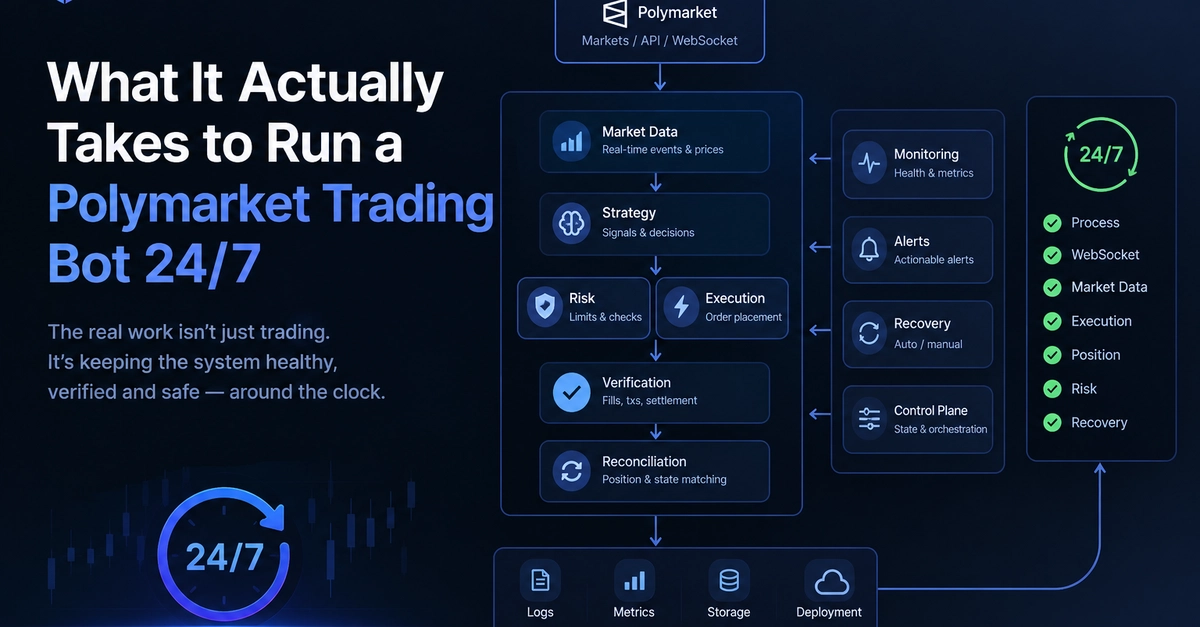
For me, a production-oriented Polymarket system looks more like:
Market Data
    ↓
Strategy
    ↓
Risk
    ↓
Execution
    ↓
Verification
    ↓
Reconciliation
    ↓
Monitoring
    ↓
Recovery
Running 24/7 means every one of those layers needs a plan for what happens when something goes wrong.
A running process is not the same as a healthy bot
The easiest health check is:
process = running
That doesn't tell you much.
The process can be alive while:
WebSocket = connected but stale
Position = wrong
Execution = unknown
Risk = unverified
Market data = outdated
So I prefer to separate:
Process Health
from:
Trading System Health
A process can be running while the trading system is paused.
That's a useful state.
Start with explicit system states
A control plane can make the operational state visible:
HEALTHY
DEGRADED
PAUSED
RECOVERING
FAILED
For example:
WebSocket disconnect
        ↓
HEALTHY
        ↓
DEGRADED
        ↓
PAUSED
After recovery:
PAUSED
   ↓
RECONNECT
   ↓
RECONCILE
   ↓
VERIFY
   ↓
RISK CHECK
   ↓
HEALTHY
This is very different from:
socket connected
↓
start trading
A connection is only one part of the system.
WebSocket connections need supervision
A trading bot depending on real-time data should assume that connections will eventually fail.
A basic connection lifecycle is:
CONNECTED
    ↓
DISCONNECTED
    ↓
RECONNECTING
    ↓
CONNECTED
But there is another question:
Is the data actually fresh?
A connection can report CONNECTED while no useful events have arrived recently.
So I would track:
last_event_time
last_connection_time
reconnect_count
last_disconnect
data_age
For example:
WebSocket:
CONNECTED

Last event:
9.4 seconds ago

Maximum allowed age:
2 seconds
That should not be considered healthy.
Reconnect doesn't mean recovered
This is one of the most important operational distinctions.
Suppose:
Event A
   ↓
Event B
   ↓
DISCONNECT
   ↓
Events C, D
   ↓
RECONNECT
The application may never have seen C and D.
So:
RECONNECTED
does not automatically mean:
STATE VERIFIED
The recovery process should be closer to:
Disconnect
   ↓
Pause
   ↓
Reconnect
   ↓
Rebuild / fetch state
   ↓
Reconcile
   ↓
Verify
   ↓
Check risk
   ↓
Resume
I've written more about this in Polymarket WebSocket recovery.
Process restarts are normal
A production system should expect restarts.
The question isn't:
“Can the process start?”
It is:
“What state should the process trust after starting?”
A safer startup sequence is:
Application starts
        ↓
Load persisted state
        ↓
Connect to external sources
        ↓
Read authoritative state
        ↓
Compare
        ↓
Repair discrepancies
        ↓
Verify risk
        ↓
Allow trading
The important part is that:
application_started
and:
trading_allowed
are separate states.
Persist state that matters
If the bot restarts, in-memory state disappears.
That means some information needs to survive the process:
orders
fills
positions
execution state
risk state
recovery state
timestamps
last known events
You don't necessarily need to persist every piece of data forever.
But you need enough information to reconstruct the trading state after a restart.
For example:
Last known position
Last known exposure
Active orders
Unresolved executions
Last reconciliation
Without this, every restart becomes a guessing exercise.
The bot needs a single source of truth for operational state
Different components can know different things.
The strategy may know:
BUY
The execution layer may know:
FILLED
The verifier may know:
TX_PENDING
The reconciliation layer may know:
POSITION_MISMATCH
The risk layer may know:
BLOCK
These aren't contradictory.
They're different views of the same system.
A control plane can combine them:
Execution = TX_PENDING
Position   = MISMATCH
Risk       = UNVERIFIED
        ↓
Trading Permission = BLOCK
That is much more useful than one global boolean.
Risk has to keep running
Risk checks cannot happen only once when the process starts.
The system can change after every execution.
A useful loop is:
Signal
   ↓
Pre-Trade Risk
   ↓
Execution
   ↓
Verification
   ↓
Position Update
   ↓
Exposure Recalculation
   ↓
Risk Recheck
This means the risk system can react to:
position changes
exposure changes
daily loss
execution failures
stale data
state mismatches
For more on that side of the system, see Polymarket Trading Bot Risk Controls.
Execution verification needs to survive restarts
Suppose the bot submitted an order and then stopped.
When it starts again, it shouldn't assume:
old local state = final execution state
The execution may have progressed while the application was unavailable.
It could be:
FILLED
TX_PENDING
CONFIRMED
SETTLED
or still unknown.
That's why I treat execution verification as a separate layer:
Order
   ↓
Fill
   ↓
Transaction
   ↓
Confirmation
   ↓
Settlement
   ↓
Position
The verifier can re-establish the execution state after a restart instead of relying entirely on stale in-memory state.
See the Polymarket Execution Verifier project.
Partial fills are an operational problem too
A 100-unit order doesn't necessarily become:
100 filled
It might become:
40 filled
60 remaining
The bot needs to keep track of:
requested quantity
matched quantity
remaining quantity
current order state
position
A restart makes this more important.
After restarting, the system needs to establish whether the remaining 60:
still exists
was filled
was cancelled
is unknown
Otherwise local position and external state can diverge.
Position state needs reconciliation
Suppose the bot restarts and thinks:
Position = +100
The account says:
Position = +40
The bot is running.
The connection is working.
The strategy is producing signals.
But the system shouldn't immediately continue trading.
The correct sequence is:
Position mismatch
        ↓
PAUSE
        ↓
Reconcile
        ↓
Verify
        ↓
Recalculate exposure
        ↓
Risk check
        ↓
Resume
That's the basic reason I treat reconciliation as infrastructure rather than a cleanup task.
Monitoring should watch conditions, not just uptime
A basic uptime monitor can tell you:
Bot process: UP
That's useful, but not sufficient.
I'd rather monitor:
Process
WebSocket
Market Data
Execution
Position
Risk
Recovery
For example:
SYSTEM HEALTH

Process        OK
WebSocket      OK
Market Data    OK
Execution      OK
Position       VERIFIED
Risk           OK
Recovery       IDLE
And during an incident:
SYSTEM HEALTH

Process        OK
WebSocket      RECOVERING
Market Data    STALE
Execution      UNKNOWN
Position       UNVERIFIED
Risk           BLOCKED
Recovery       ACTIVE
Now the operator knows what is wrong.
Alerts should correspond to real actions
An alert is useful when someone or something can act on it.
Examples:
MARKET_DATA_STALE
WEBSOCKET_DISCONNECTED
POSITION_MISMATCH
EXECUTION_UNKNOWN
RISK_LIMIT_BREACHED
RECOVERY_STARTED
RECOVERY_FAILED
The system can then decide:
alert only
or:
pause trading
or:
start recovery
or:
require operator intervention
I don't want alerts that are just noise.
Metrics become more useful after the bot has been running
Once the basic operating model works, start measuring execution behavior.
Useful metrics include:
order latency
fill latency
fill ratio
partial-fill rate
rejection rate
unknown execution count
position mismatch count
reconciliation duration
recovery duration
The important part is not collecting hundreds of numbers.
It's identifying changes.
For example:
Fill latency ↑
Rejections ↑
Unknown states ↑
Recovery time ↑
That combination is much more interesting than any one number by itself.
That's the focus of the execution analytics work in this cluster.
Incident recovery needs history
If something goes wrong at 03:00, I don't want the only answer to be:
Bot restarted at 03:02
I want to know:
What happened?
When did it start?
What was the last verified state?
Which orders were active?
What fills were observed?
What became unknown?
What did reconciliation find?
What risk state existed?
Why was trading resumed?
A useful incident timeline might look like:
03:01:08  Order submitted
03:01:09  Fill observed
03:01:10  WebSocket disconnected
03:01:11  Trading paused
03:01:18  Process stopped
03:02:03  Process restarted
03:02:04  Recovery started
03:02:05  Reconciliation started
03:02:07  Position verified
03:02:08  Risk check passed
03:02:09  Trading resumed
That is much more useful than a simple uptime record.
I've written about this in Polymarket Trading Bot Incident Recovery.
Resource limits matter too
24/7 operation isn't only about trading state.
The process itself uses:
CPU
Memory
Disk
Network
Connections
File descriptors
A system that slowly accumulates memory or logs can eventually fail even if the trading logic is correct.
So production monitoring should include basic process-level signals:
memory usage
CPU usage
disk usage
restart count
connection count
error rate
The exact limits depend on the deployment environment.
The important part is noticing the trend before the process becomes unstable.
Logging should support investigation
A trading system needs logs that are useful during failures.
For example:
execution_id
order_id
trade_id
market_id
event_type
state
timestamp
reason
Avoid logs like:
something failed
Prefer:
EXECUTION_STATE_CHANGED
execution_id=abc123
from=FILLED
to=TX_PENDING
reason=transaction_not_available
This makes later analysis much easier.
Sensitive credentials should never appear in logs.
Deployment is part of the system
A 24/7 bot needs a predictable runtime environment.
That means thinking about:
process supervision
automatic restart
environment configuration
secrets
network access
logging
storage
health checks
resource limits
The exact deployment can vary.
VPS, container, cloud VM, or another environment can all work.
The engineering requirement is the same:
The bot should fail in a controlled way rather than silently disappearing.
Automatic restart isn't enough
A supervisor can restart a process.
For example:
process dies
   ↓
supervisor restarts
Good.
But that doesn't guarantee safe trading.
The trading system still needs:
restart
   ↓
load state
   ↓
reconcile
   ↓
verify
   ↓
risk check
   ↓
resume
Otherwise the supervisor may simply restart the same incorrect state over and over.
A simple 24/7 architecture
Putting these ideas together:
                    POLYMARKET
                        |
                        v
                 Market Data / API
                        |
                        v
                   Trading Bot
                        |
              +---------+---------+
              |                   |
              v                   v
           Strategy              Risk
              |                   |
              +---------+---------+
                        |
                        v
                    Execution
                        |
                        v
                Execution Verifier
                        |
                        v
                Position Reconcile
                        |
                        v
                 Control Plane
                        |
          +-------------+-------------+
          |             |             |
          v             v             v
      Monitoring      Alerts       Recovery
          |
          v
       Metrics
The system is no longer just:
strategy → order
It is an operational loop.
What should happen when the system gets unhealthy?
The reaction should depend on the problem.
For example:
Market data stale
        ↓
Pause
or:
Position mismatch
        ↓
Reconcile
        ↓
Verify
or:
Risk limit breached
        ↓
Block
        ↓
Operator / recovery process
or:
WebSocket disconnect
        ↓
      Pause
        ↓
   Reconnect
        ↓
    Recover
        ↓
     Resume
The important part is that the response is defined before the incident happens.
24/7 operation is mostly about boundaries
The longer a bot runs, the more important system boundaries become.
You need to know where:
strategy
execution
verification
state
risk
monitoring
recovery
begin and end.
A strategy failure shouldn't necessarily become a process failure.
A WebSocket failure shouldn't automatically become a strategy failure.
A position mismatch shouldn't become silent extra exposure.
An execution uncertainty shouldn't become fake success.
A restart shouldn't automatically mean trading is safe.
Those boundaries are what make continuous operation manageable.
A practical 24/7 checklist
Before calling a Polymarket bot production-oriented, I'd want:
[ ] Process supervision
[ ] Persistent state
[ ] WebSocket reconnect handling
[ ] Market-data freshness checks
[ ] Execution verification
[ ] Position reconciliation
[ ] Risk controls
[ ] Pause / resume
[ ] Recovery workflow
[ ] Structured logs
[ ] Metrics
[ ] Alerts
[ ] Resource monitoring
[ ] Restart recovery
[ ] Incident history
[ ] CI / tests
The exact implementation will vary.
The important thing is that every box has an actual behavior behind it.
The broader system I'm building
This is where the different Polymarket projects start fitting together:
Polymarket Trading Bot
        ↓
    Execution
        ↓
Execution Verifier
        ↓
Position Reconciliation
        ↓
  Risk Controls
        ↓
Trading Control Plane
        ↓
Monitoring / Analytics
        ↓
Incident Recovery
The bot is the part that trades.
The rest is what allows it to operate continuously.
That distinction is becoming more important as I work on the infrastructure around it.
Final takeaway
Running a Polymarket bot for a few hours isn't the same engineering problem as running one continuously.
For 24/7 operation, the system needs to handle:
disconnects
restarts
partial fills
state mismatches
execution uncertainty
risk breaches
stale data
resource problems
incidents
recovery
The basic operating loop becomes:
Run
 ↓
Observe
 ↓
Verify
 ↓
Reconcile
 ↓
Control
 ↓
Recover when needed
 ↓
Continue
The goal isn't to build a bot that never fails.
That's not realistic.
The goal is to build a system that fails visibly, recovers deliberately, and never assumes that a running process means trading is safe.
Top comments (0)
For further actions, you may consider blocking this person and/or reporting abuse